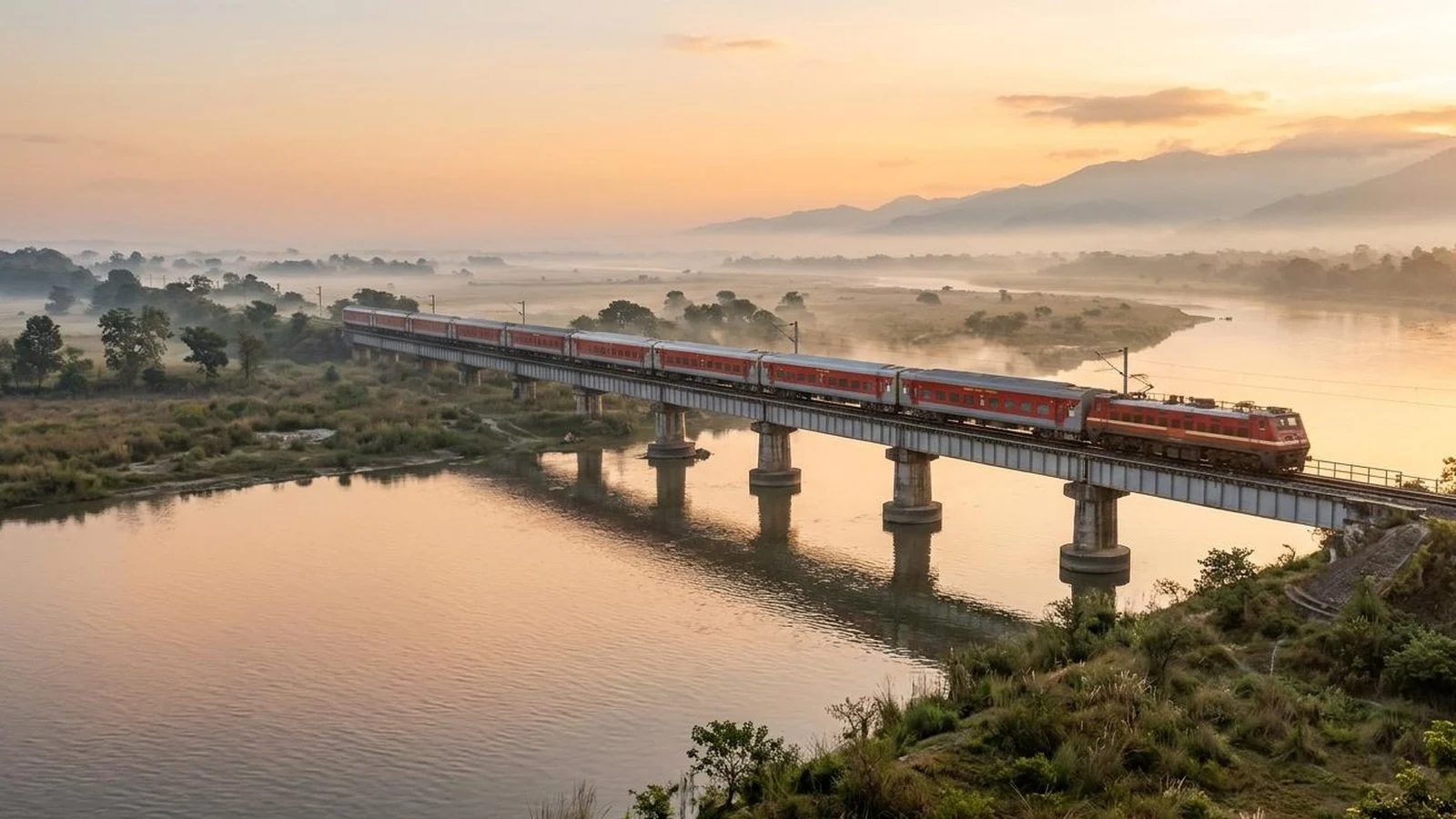
The Saryu Kamla Express marks one of the most exciting and culturally significant milestones in South Asian cross-border rail travel in decades. On November 23, 2026, I watched with immense joy and anticipation as Indian Prime Minister Narendra Modi and Nepal Prime Minister Balendra Shah jointly flagged off this landmark weekly cross-border train service (Train 15595 / 15596), directly linking Ayodhya Dham in Uttar Pradesh with Janakpur Dham in Nepal’s Madhesh Province. As an Indian traveler who has spent years documenting slow train journeys, Himalayan trekking paths, and sacred pilgrimage routes across our subcontinent, the inauguration of this direct broad-gauge link is far more than a routine update to the railway timetable. It bridges two sacred river basins—the historic Saryu flowing past the temple ghats of Ayodhya and the sacred Kamla winding through the Mithila plains of Nepal—stitching together centuries of shared cultural memory, family ties, and living devotion into an unbroken 604-kilometer rail journey.
For generations, traveling between Ayodhya and Janakpur meant enduring an exhausting, multi-stage overland ordeal. Pilgrims, backpackers, and cross-border families had to piece together crowded local trains to the border, scramble for shared jeeps, walk on foot across dusty border checkpoints carrying heavy luggage under blazing heat, and navigate unfamiliar transport networks on the other side. The Saryu Kamla Express fundamentally transforms that grueling two-day trial into a dignified, comfortable, overnight journey of roughly 18 to 19 hours aboard modern Linke Hofmann Busch (LHB) coaches. In this comprehensive guide, I have pulled together everything you need to plan this journey: exact station-by-station timetables with arrival, departure, and halt times in both directions, border customs procedures at Jaynagar, coach configurations, ticketing quotas, and practical travel advice from my own route notes.
Saryu Kamla Express at a Glance (15595 / 15596)
- Service Type & Route: International Weekly Broad-Gauge Express connecting Ayodhya Cantt (AYC) / Ayodhya Dham (AY) with Janakpur Dham, Nepal (JKP) via Gorakhpur and Jaynagar.
- Train Numbers & Schedule: Train 15596 departs Ayodhya every Monday at 17:50 IST; Train 15595 departs Janakpur Dham every Saturday at 13:10 NPT.
- Total Distance & Running Time: ~604 kilometers in approximately 18 hours 50 minutes (outbound) and 19 hours 00 minutes (return).
- En-Route Commercial Halts: 10 major intermediate stations across Uttar Pradesh, Northern Bihar, and Southern Nepal.
- Rake & Seating Capacity: 17 modern LHB coaches accommodating 1,158 passengers across 2A, 3A, 3E, and Sleeper (SL) classes (strictly no unreserved General and no First AC).
- International Border Protocol: Dedicated customs, luggage scanning, and passenger document verification halt at Jaynagar Station (2 hours outbound, 1 hour inbound).
- Booking Standard: Confirmed reservations only; RAC and Waitlisted passengers are not permitted across the border.
Why the Saryu Kamla Express Matters: Reconnecting the Ramayana Corridor
The launch of the Saryu Kamla Express represents only the second international broad-gauge passenger railway service between India and Nepal, following the successful introduction of the Jaynagar–Kurtha regional DMU trains in 2022. However, while the earlier service was primarily a short-distance commuter lifeline across the border, the Saryu Kamla Express is a full-fledged long-distance express connecting two of the most significant spiritual and cultural capitals of South Asia. As reported extensively across national and international publications, including Mint’s coverage of the landmark rail launch and regional news in Nepal, the service has been met with extraordinary excitement on both sides of the border.
To truly appreciate why this train resonates so deeply, one must understand the unique relationship shared between India and Nepal, traditionally celebrated as roti-beti ka rishta (a relationship bound by shared bread and matrimonial ties). In the ancient epic Ramayana, Lord Ram traveled from Ayodhya to Janakpur to wed Mata Sita, the beloved daughter of King Janak. Traditional accounts hold that the royal wedding procession—the sacred Baraat—spent over four arduous weeks walking across dense forests, marshlands, and unpaved riverbeds between the two kingdom capitals. For centuries since, thousands of devotees have retraced segments of that route on foot during festivals like Vivah Panchami. Today, the Saryu Kamla Express retraces that sacred geography in comfort, allowing pilgrims and travelers to complete the entire pilgrimage circuit over a single weekend.
Furthermore, this rail line represents a crucial geopolitical infrastructure victory. Constructed with Indian grant assistance through IRCON International, the railway track currently runs from Jaynagar on the Indian border through Kurtha to Bijalpura in Nepal. Active construction is underway to extend this track another 17 kilometers to Bardibas by March 2029, where it will eventually integrate directly into Nepal’s planned East-West Electric Railway (Mahendra Highway Rail Grid). Sitting by the train window as it glides past tranquil mango orchards, mustard fields, and village ponds, you are literally witnessing the modern rebirth of ancient subcontinental connectivity.
Route Overview: Crossing Three States and Two Sovereign Nations
Spanning approximately 604 kilometers, the journey of the Saryu Kamla Express weaves through a fascinating tapestry of geographical landscapes and distinct cultural linguistic zones. Starting from the fertile Awadh plains around Ayodhya, the train journeys through Purvanchal in Eastern Uttar Pradesh, passes the Himalayan foothills of West Champaran in Bihar, traverses the historic Mithilanchal heartland of Northern Bihar, and crosses the international frontier into the Madhesh Terai of Nepal.
Along this expansive corridor, the railway authorities have carefully scheduled 10 intermediate commercial halts between the originating terminal at Ayodhya Cantt / Ayodhya Dham and the final destination at Janakpur Dham. Each stop serves a distinct logistical or cultural purpose:
- Ayodhya Cantt (AYC) & Ayodhya Dham (AY): The sacred twin rail heads in Uttar Pradesh, welcoming thousands of devotees visiting the grand Ram Janmabhoomi temple, Hanumangarhi, and Saryu Ghats.
- Mankapur Junction (MUR): A vital regional junction in Gonda district where travelers from Balrampur, Shravasti, and northern UP connect onto mainline express routes.
- Basti (BST): A key commercial district headquarters in eastern Uttar Pradesh offering seamless transit for regional travelers.
- Gorakhpur Junction (GKP): The sprawling headquarters of North Eastern Railway and home to the world-renowned Gorakhnath Temple, acting as the primary passenger exchange hub along this line.
- Narkatiaganj Junction (NKE): Situated in Bihar’s West Champaran district near the foothills of the Himalayas, this station serves as a crucial technical and crew change point.
- Raxaul Junction (RXL): One of the busiest trade border gates between India and Nepal, located directly opposite Birgunj, facilitating commercial passenger connections.
- Sitamarhi Junction (SMI): Celebrated in sacred tradition as Punaura Dham, the revered birthplace of Mata Sita, making it an essential spiritual halt on the Ramayana circuit.
- Shisho Halt (SSHP): A strategic bypass stop serving the wider Darbhanga educational and commercial region.
- Madhubani (MBI): The globally celebrated epicenter of traditional Mithila / Madhubani folk art, where station walls themselves are adorned with vibrant handmade murals.
- Jaynagar (JYG): The Indian border terminal station where the train halts for extensive international customs inspection, railway police verification, and document checks.
- Janakpur Dham (JKP): The final international terminus in Nepal’s Madhesh Province, located just a short rickshaw ride from the magnificent marble Janaki Mandir.
Complete Station-by-Station Timetables & Halts (Both Directions)
To help you plan your journey down to the exact minute—whether you are booking end-to-end tickets or boarding at intermediate stations like Gorakhpur, Sitamarhi, or Jaynagar—I have compiled the comprehensive station-by-station timetables for both the outbound (Train 15596) and return (Train 15595) services below, based on official operational schedules.
Important Note on the 15-Minute Time Zone Offset: India operates on Indian Standard Time (IST, UTC+5:30), while Nepal operates on Nepal Standard Time (NPT, UTC+5:45). Nepal is exactly 15 minutes ahead of India. In the tables below, Indian stations follow IST, while Janakpur Dham arrival and departure are recorded in official Nepal Standard Time (NPT) with the IST equivalent noted to ensure you never miss a connection.
Train 15596 Timetable: Ayodhya Cantt to Janakpur Dham (Outbound Every Monday)
| Stop # | Station Name (Code) | Arrival Time | Departure Time | Halt Duration | Day | Distance (km) | Route & Operational Notes |
|---|---|---|---|---|---|---|---|
| 1 | Ayodhya Cantt (AYC) | Origin | 17:50 IST | — | Monday | 0 km | Main originating platform; board at least 30 mins before departure. |
| 2 | Ayodhya Dham (AY) | 18:05 IST | 18:10 IST | 5 mins | Monday | 7 km | Convenient boarding halt closer to temple town and Ram Janmabhoomi. |
| 3 | Mankapur Junction (MUR) | 18:55 IST | 19:00 IST | 5 mins | Monday | 45 km | Junction point connecting regional lines from Gonda and Balrampur. |
| 4 | Basti (BST) | 19:50 IST | 19:55 IST | 5 mins | Monday | 106 km | Primary passenger halt for Eastern Uttar Pradesh districts. |
| 5 | Gorakhpur Junction (GKP) | 22:13 IST | 22:23 IST | 10 mins | Monday | 170 km | Major junction halt; ideal for picking up dinner and packaged snacks. |
| 6 | Narkatiaganj Junction (NKE) | 01:50 IST | 02:20 IST | 30 mins | Tuesday | 320 km | Overnight technical operational halt and locomotive safety inspection. |
| 7 | Raxaul Junction (RXL) | 03:15 IST | 03:20 IST | 5 mins | Tuesday | 361 km | Major commercial transit point along the Indo-Nepal trade highway. |
| 8 | Sitamarhi Junction (SMI) | 04:42 IST | 04:47 IST | 5 mins | Tuesday | 443 km | Sacred birthplace of Mata Sita at Punaura Dham; early morning arrival. |
| 9 | Shisho Halt (SSHP) | 06:10 IST | 06:12 IST | 2 mins | Tuesday | 510 km | Brief stop serving rural Darbhanga and Mithilanchal commuters. |
| 10 | Madhubani (MBI) | 07:05 IST | 07:10 IST | 5 mins | Tuesday | 538 km | Mithila art cultural center; vibrant hand-painted platform walls. |
| 11 | Jaynagar (JYG) | 08:30 IST | 10:30 IST | 120 mins (2 hrs) | Tuesday | 570 km | International Border Check: Mandatory customs, police verification, and document clearance. |
| 12 | Janakpur Dham (JKP) | 12:40 NPT (12:25 IST) |
Terminus | — | Tuesday | 604 km | Final destination in Nepal; easy e-rickshaws available to Janaki Mandir. |
Train 15595 Timetable: Janakpur Dham to Ayodhya Cantt (Return Every Saturday)
| Stop # | Station Name (Code) | Arrival Time | Departure Time | Halt Duration | Day | Distance (km) | Route & Operational Notes |
|---|---|---|---|---|---|---|---|
| 1 | Janakpur Dham (JKP) | Origin | 13:10 NPT (12:55 IST) |
— | Saturday | 0 km | Afternoon departure from Nepal; ensure you arrive at station by 12:15 NPT. |
| 2 | Jaynagar (JYG) | 14:10 IST | 15:10 IST | 60 mins (1 hr) | Saturday | 34 km | Indian Inbound Border Check: Customs declaration, bag scanning, and ID check. |
| 3 | Madhubani (MBI) | 15:45 IST | 15:50 IST | 5 mins | Saturday | 66 km | Boarding halt for passengers returning from northern Mithila region. |
| 4 | Shisho Halt (SSHP) | 16:30 IST | 16:32 IST | 2 mins | Saturday | 94 km | Quick regional stop for local transfers towards Darbhanga. |
| 5 | Sitamarhi Junction (SMI) | 19:00 IST | 19:05 IST | 5 mins | Saturday | 161 km | Evening stop in Northern Bihar; popular dinner pickup point. |
| 6 | Raxaul Junction (RXL) | 20:10 IST | 20:15 IST | 5 mins | Saturday | 243 km | Border crossing junction connecting central Nepal trade travelers. |
| 7 | Narkatiaganj Junction (NKE) | 22:50 IST | 22:55 IST | 5 mins | Saturday | 284 km | Late evening halt before the night run across Purvanchal. |
| 8 | Gorakhpur Junction (GKP) | 03:55 IST | 04:05 IST | 10 mins | Sunday | 434 km | Early dawn arrival; important transfer junction for Lucknow/Delhi lines. |
| 9 | Basti (BST) | 05:15 IST | 05:20 IST | 5 mins | Sunday | 498 km | Early morning halt; tea and breakfast vendors open on platforms. |
| 10 | Mankapur Junction (MUR) | 06:15 IST | 06:20 IST | 5 mins | Sunday | 559 km | Morning stop facilitating regional disembarkation in Gonda. |
| 11 | Ayodhya Dham (AY) | 07:30 IST | 07:35 IST | 5 mins | Sunday | 597 km | Prime deboarding stop for pilgrims going straight to Ram Mandir morning darshan. |
| 12 | Ayodhya Cantt (AYC) | 08:10 IST | Terminus | — | Sunday | 604 km | Final arrival back in Ayodhya Cantt; easy connections to Lucknow and Delhi. |
Inside the Train: 17 LHB Coaches, Class Breakdown & Missing Options
The Saryu Kamla Express operates using Linke Hofmann Busch (LHB) coaches designed and manufactured by Indian Railways. Compared to traditional ICF blue rakes, modern LHB coaches offer significantly improved passenger safety with anti-collision couplers, advanced disc brakes, smooth secondary air suspensions that minimize track jerk, and wide sound-insulated windows that allow wonderful panoramas of the rural countryside.
The train runs with a fixed 17-coach formation accommodating up to 1,158 passengers. The exact coach anatomy consists of:
- AC 2-Tier (2A): Spacious, curtained privacy compartments with wide berths and reading lamps, ideal for travelers wanting peaceful night rest.
- AC 3-Tier (3A): Traditional three-tier air-conditioned sleeper berths, clean and temperature-controlled.
- AC 3-Economy (3E): A newer, cost-effective air-conditioned class with a modified berth geometry that offers high-comfort cooling at a budget-friendly price point.
- Sleeper Class (SL): 7 non-AC sleeper coaches equipped with openable mesh windows, ceiling fans, and standard berths—favored by budget pilgrims and families.
- End-on-Generation (EOG) & Luggage Vans: 2 specialized power cars placed at both ends of the train housing heavy diesel generators for air-conditioning and lighting, along with railway postal/parcel storage.
Two Crucial Missing Classes to Keep in Mind: When planning your trip, note that the Saryu Kamla Express has strictly NO First AC (1A) coaches and NO Unreserved General (UR) coaches. If you are accustomed to luxury coupe travel in First AC, you will need to adjust expectations and reserve AC 2-Tier. More importantly, budget backpackers cannot simply buy an unreserved ticket at the station counter on the day of departure—every single passenger on this train must hold a confirmed reserved seat.
Strict Ticketing Rules: Confirmed-Only Policy & the 70/30 Quota Split
Because the Saryu Kamla Express crosses an international frontier between India and Nepal, the Ministry of Railways and Nepal Railways have established specialized ticketing regulations to maintain security oversight and manage border clearance efficiently.
1. Confirmed-Only Boarding (Zero RAC, Zero Waitlist): Unlike standard Indian domestic trains where passengers with RAC (Reservation Against Cancellation) or partially confirmed waitlist tickets are permitted to board, the Saryu Kamla Express operates strictly under a Confirmed-Only Mandate. If your ticket remains on the Waitlist (WL) or in RAC status after chart preparation, you are strictly prohibited from boarding. Immigration and railway security officials at Jaynagar verify passenger manifests against physical manifests; unconfirmed passengers will be removed from the train before reaching the international track.
2. The 70% / 30% Quota Allocation: Seat inventory is split into two pools:
- 70% End-to-End Quota: Dedicated exclusively for passengers traveling between Ayodhya (Cantt / Dham) and Janakpur Dham. This guarantees that international pilgrims have priority access to long-distance berths.
- 30% Intermediate Quota: Allocated for travelers boarding or deboarding at intermediate stations such as Gorakhpur, Narkatiaganj, Sitamarhi, and Madhubani. If you find intermediate berths sold out, checking the end-to-end quota from Ayodhya often unlocks available seats.
3. Absence of Special Concession Quotas: Standard domestic railway concessions—such as Senior Citizen lower berth quotas or Divyangjan quotas—are not applicable on this international service. When booking tickets for elderly family members, I strongly recommend booking as soon as the reservation window opens on IRCTC so you can manually select and secure lower berths during reservation.
International Border Protocols at Jaynagar: What to Expect
Crossing from India into Nepal aboard an express train is a remarkably unique travel experience, but it requires patience and proper preparation. Jaynagar station serves as the dedicated customs and immigration fortress for this international route. Unlike ordinary stops where a train halts for five minutes, the Saryu Kamla Express halts at Jaynagar for 2 full hours on the outbound journey (08:30 to 10:30 IST) and 1 hour on the return journey (14:10 to 15:10 IST).
During this extended halt, joint teams of Indian Customs, Border Security Force (BSF) / Sashastra Seema Bal (SSB), Government Railway Police (GRP), and Nepal Police board the coaches. Here is how to navigate this check smoothly:
- Mandatory Identity Documents: While Indian and Nepali citizens enjoy a visa-free travel treaty, you MUST carry original physical government photo identification. Indian citizens must present either a valid original Indian Passport OR an original Voter ID card (issued by the Election Commission of India). Please note: Standard Aadhaar cards, PAN cards, or digital driving licenses stored on DigiLocker are generally not accepted as primary cross-border identity cards for international rail transit.
- Documents for Minors & Children: Children traveling with parents must carry their original birth certificate or a recognized school photo ID card accompanied by their parents’ verified Voter ID or Passport.
- Documents for Nepali Citizens: A valid original Nepali Citizenship Certificate (Nagrikta) or Nepali Passport.
- Currency Regulations: Indian rupees are widely accepted across Nepal, particularly in the border plains of Janakpur. However, by official regulation of Nepal Rastra Bank, carrying Indian currency notes in denominations of ₹500 or ₹200 is subject to strict limits or restrictions. I strongly advise carrying clean ₹100, ₹50, and ₹20 notes, or exchanging your cash at licensed money exchange counters near Janakpur station.
- Mobile Network & Roaming: As the train crosses from Jaynagar into Nepal, Indian telecom networks (Jio, Airtel, Vi) will switch to international roaming. To avoid unexpected roaming charges, turn off mobile data before reaching Jaynagar. In Janakpur, you can easily purchase a local Nepali SIM card (Ncell or Nepal Telecom Namaste) right outside the station using your passport or Voter ID copy.
My 4-Day Ayodhya–Janakpur Pilgrimage Circuit Itinerary
Because the Saryu Kamla Express operates on a weekly cycle—departing Ayodhya on Monday evening and returning from Janakpur on Saturday afternoon—it creates the perfect framework for an unforgettable 4-day cross-border pilgrimage and cultural discovery tour. Here is the exact itinerary I recommend to make the most of this journey:
Sunday & Monday: Immersing in Ayodhya Dham
Arrive in Ayodhya on Sunday morning. Check into a guesthouse near Naya Ghat, attend the mesmerizing evening Saryu Aarti, and sample local Awadhi breakfast delicacies like bedmi puri and kachori. Spend Monday visiting the grand Ram Janmabhoomi temple complex, the fortified Hanumangarhi temple, and the palace of Kanak Bhawan. In my earlier guide on the pilgrimage circuit from Delhi to Ayodhya and the Divine East, I shared route notes on navigating Ayodhya’s temple streets during peak seasons. By 16:30 on Monday, head to Ayodhya Cantt station with your tickets and documents ready to board Train 15596 at 17:50.
Tuesday: Arrival in Janakpur Dham & First Impressions
Wake up early Tuesday morning as the train travels past the colorful station walls of Madhubani into Jaynagar. Complete your border verification during the 2-hour halt, and enjoy the scenic crossing across the border into Nepal’s Madhesh Province. The train arrives at Janakpur Dham at 12:40 NPT. Check into your hotel, rest, and head out in the late afternoon to visit the breathtaking Janaki Mandir. Constructed in 1910 by Queen Vrisha Bhanu of Tikamgarh at a cost of nine lakh silver rupees, this stunning palace temple—popularly called the Naulakha Mandir—features 60 interconnected chambers, brilliant white marble domes, and a rare architectural blend of Mughal arches and Rajput stone filigree.
Wednesday & Thursday: Sacred Ponds, Vivah Mandap & Mithila Art
Dedicate your days to exploring the spiritual sites surrounding the temple. Walk through the Vivah Mandap, an open-air stone pavilion where Lord Ram and Mata Sita’s celestial wedding ceremony is traditionally commemorated with life-sized marble statues. Stroll around Janakpur’s sacred water bodies, especially Dhanush Sagar and Ganga Sagar, where evening aartis cast flickering oil reflections across the water. Visit local artisan cooperatives to observe women painting authentic Mithila art on handmade paper, capturing timeless folklore in intricate natural pigments.
If you are fond of long spiritual journeys and high-altitude mountain sanctuaries, you might enjoy reading my guide on the sacred Sapta Badri temples of Uttarakhand, or my cinematic travel notes on planning a week along the Ganges in Haridwar and Rishikesh. If you appreciate vibrant cultural celebrations, my reflection on the cultural extravaganza of Mathura Holi highlights similar deep-rooted folk traditions.
Friday: Savoring Mithila Flavors & Border Markets
Food is an extraordinary part of this journey. The cuisine of Janakpur blends traditional Mithila cooking with Nepalese warmth. Indulge in classic dishes like chokha-litti, fragrant makhana kheer, fresh curd served in earthen pots, and Nepalese dal bhat tarkari. If you love international travel and often wonder how to order wholesome plant-based food across borders, take a look at my Global Vegetarian language guide for ordering veg food abroad.
Saturday: Boarding Train 15595 Back to India
After a leisurely Saturday morning breakfast, take a rickshaw to Janakpur Dham station by 12:15 NPT. Train 15595 departs promptly at 13:10 NPT. Complete return customs at Jaynagar, sleep through the night across Bihar and UP, and arrive refreshed in Ayodhya Cantt on Sunday morning at 08:10 IST, ready to head back home.
Actionable Traveler Checklist for the Saryu Kamla Express
- Original Voter ID or Passport Only: Do not rely on your Aadhaar card or phone screenshots. Physical Voter IDs or Passports are mandatory for adults at the Jaynagar border inspection.
- Never Board with RAC or Waitlist: Only fully confirmed berths are permitted on this international train. Check your PNR status on IRCTC before leaving home.
- Carry Small Denomination Indian Cash: Carry ₹100, ₹50, and ₹20 notes. Do not bring ₹500 or ₹200 notes into Nepal to prevent currency confiscation during customs checks.
- Pack Drinking Water and Snacks for Jaynagar: The 2-hour scheduled border halt at Jaynagar can feel lengthy while security checks are conducted. Having personal water bottles and snacks will keep you comfortable.
- Remember the 15-Minute Clock Shift: Nepal Standard Time is 15 minutes ahead of IST. Adjust your watch so you are never late for station arrivals or local connections.
- Choose 2A or 3A for Maximum Quiet: While Sleeper (SL) coaches are budget-friendly, the air-conditioned coaches (2A, 3A, 3E) provide sealed windows and quiet interiors during overnight transit across Bihar.
- Book 60–90 Days in Advance: With only one weekly frequency and a 70% direct quota, berths sell out rapidly around major festivals like Vivah Panchami and Ram Navami.
Personal Reflections: The Unbroken Thread of South Asian Rail Travel
Standing on the platform in Ayodhya and watching the green flag wave as the Saryu Kamla Express pulled away toward Nepal brought a quiet wave of emotion. For years, borders in our region have too often been defined by friction, delays, and barriers. Yet railways have an uncanny power to heal historical divides. When steel tracks stretch across international boundaries, they do more than carry tourists and cargo—they weave communities together, honor shared civilizational roots, and turn what was once an exhausting geographic hurdle into a peaceful, overnight journey under the stars.
Whether you are setting out on a deeply personal pilgrimage to Janaki Mandir, tracing the timeless cultural footprint of Awadh and Mithila, or simply seeking the thrill of boarding a train in India and stepping off in Nepal, the Saryu Kamla Express is a journey worth taking. Book your berths early, keep your physical documents close, embrace the rhythms of the border rails, and enjoy every mile of this sacred South Asian corridor. Safe travels, and I hope to see you somewhere down the track!

